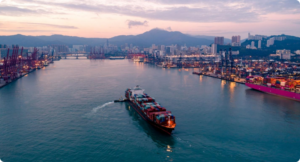
Southern China’s Greater Bay Area (GBA) is a 56,000 sq km economic zone embracing nine mainland Chinese cities — including commercial powerhouse Guangzhou and high-tech Shenzhen — as well as the thriving Chinese special administrative regions of Macau and Hong Kong.

Already compared to the bay areas of New York City, Tokyo and San Francisco, China’s GBA had a total population of 86mn with a combined GDP of US$1.88tn at the end of 2021. Hong Kong’s Financial Services Development Council (FSDC), established to promote that city’s financial services industry, says that now makes the GBA the wealthiest region in the world.

Hong Kong’s pivotal role in the GBA, the FSDC adds, makes it the ideal conduit between mainland China and the world, and the city is primed to benefit. “With complementary advantages of respective markets and systems in the GBA, the financial services industry in Hong Kong has much expectation on the coordinated development of the region,” says FSDC chairman Laurence Li Lu-jen.

Vital cross-border connections

Hong Kong has been an effective gateway to China for decades, of course, and thanks to its popular Stock Connect, Bond Connect, Wealth Management Connect and new ETF Connect and other programmes, “Asia’s world city” is now unique among global financial centres in offering international investors access to the stock exchanges in Shanghai — the world’s largest by market cap outside the US — and Shenzhen, as well as access to mainland China’s onshore fixed income market, which was worth $17.5tn at the end of 2020, second only to the US.

“The Connect schemes broaden the investment opportunity set for institutional and retail investors on both sides of the China border,” says Janet Li, partner and Asia wealth business leader at asset manager Mercer. “With diversification being the golden rule of investment and given the pressure to deliver yield in spite of inflationary and macro risks, these channels enable further enhancement of portfolio value via strategic and tactical allocations.”

International investors are now able to conveniently and efficiently participate in China’s impressive growth story, and Chinese investors are able to diversify their portfolios with increased global exposure.

“Eight years after the launch of Shanghai-Hong Kong Stock Connect scheme in 2014, we finally saw ETFs being added into the eligible securities this year,” says Ding Chen, chief executive at CSOP Asset Management. “ETF Connect, based on the Stock Connect scheme’s framework, allows mainland investors to trade the eligible ETFs listed in Hong Kong directly under their Stock Connect trading account, and vice versa.”

When it comes to ETFs, Ding says, Hong Kong offers Hong Kong equities, China A-shares, Asia-Pacific and overseas equities, fixed income investments and commodities, as well as leveraged and other products. “Through the ETF Connect scheme and others, China onshore investors can enjoy the wide range of product offerings in Hong Kong, while global investors can invest in China, facilitated by professional services with international standards.”

ETF Connect was launched on July 4 of this year and Ding adds: “According to Hong Kong Stock Exchange data, the total ETF Connect trading volume northbound was Rmb523mn as of August 5, while southbound trading reached HK$5.85bn, showing strong demand for Hong Kong ETFs from mainland investors, despite the fact that there are over 80 mainland ETFs while only four Hong Kong ETFs are eligible for the scheme.”


Trade in renminbi, easy as ABC

According to the FSDC, most of the world’s renminbi payments are settled through Hong Kong, with volumes still growing. Hong Kong is also a leading renminbi financing centre, hosting the largest offshore renminbi bond market and playing a key role in the currency.

“According to Swift’s report in July 2022, Hong Kong accounts for 74 per cent of all offshore renminbi payments,” says Ding. With a wide range of renminbi products and expertise, she adds, renminbi assets not only “come to Hong Kong” but also “stay in Hong Kong”.

Meanwhile the convergence of financial regulation in Hong Kong, the GBA and China as a whole has been underway for some time, with regulators on both sides working together in areas ranging from accounting, cryptocurrency, anti-money laundering and environmental, social and governance (ESG) regulation to risk management.

“This convergence has been going on now for nearly two decades, since the mainland-Hong Kong Closer Economic Partnership Agreement (CEPA) was signed in 2003, providing preferential trade access and investment policies to Hong Kong-based companies,” says Li.

“The preferential treatment included liberalising measures such as allowing wholly owned enterprises in the mainland, relaxing equity share restrictions and reducing registered capital requirements,” she adds.

A meeting of financial minds

Convergence of regulation between Hong Kong and the mainland took months, even years, for each Connect scheme, Ding says, and involved input from multiple stakeholders from both markets. “It covers not only financial regulatory framework, but also aspects such as settlement, risk management and sales distribution.”

The flow of information and expertise has also increased in the past two decades, with collaboration between governments and regulators on the mainland, in Hong Kong and Macau having yielded a range of technology-related developments such as the expansion of Hong Kong’s Cyberport business park, establishment of Hong Kong Science and Technology Parks Corporation, research and development (R&D) tax incentives and cross-boundary technology cooperation.

Ultimately, and especially with the GBA developing at pace, Hong Kong’s traditional role as the world’s gateway to China is now set to enjoy a boost. The FSDC has reported that many Hong Kong financial services companies, for example, including 51 per cent of its fintech firms, are looking to expand into the area.

“Hong Kong is a place of value discovery for both investors and Chinese companies,” says Ding. “With close ties with the mainland market, easier communication and similar cultural background, Hong Kong has attracted investors who are not only interested in, but also understand and believe in the China story from a long-term perspective.

Li agrees, saying: “The strong and long-tested ties give confidence to global investors who have continued to invest via Hong Kong, to tap into broadened opportunities in mainland China. The benefits are manifold and lead to an even more robust financial system in Hong Kong.”

Reference: Financial Times 

(https://www.ft.com/partnercontent/hkfsdc/why-hong-kong-is-still-the-gateway-to-china.html)